
Designing for the Los Angeles Hillside
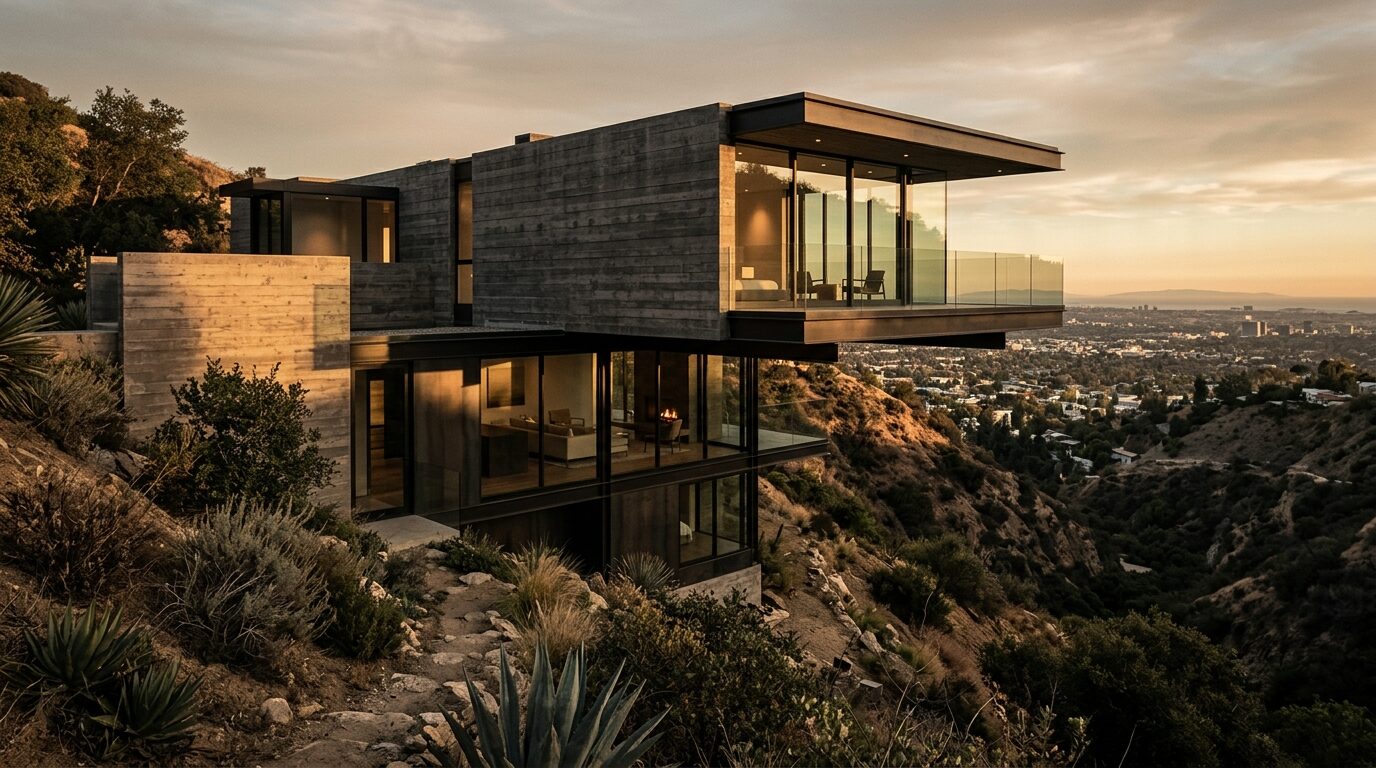
In Los Angeles, the hillside is never a blank page. Before a single wall is drawn, the slope has already made most of the important decisions — where the light lands, where the view opens, how you arrive. The work is learning to listen to it.
Flat sites invite you to impose a plan. A hillside refuses that. It asks a harder and more interesting question: not what do you want to build, but what does this ground already want to become. The grade, the orientation, the way morning light rakes across one elevation while another sits in shade all afternoon — these are constraints, but they are also the entire brief if you let them be.
The slope draws the first line
A good hillside design begins with the section, not the plan. How the building steps, cantilevers, or nestles into the grade determines everything that follows: the sequence of arrival, the height of the ceilings, the moment the view is revealed. Fight the slope and you spend the budget on retaining walls and apology. Work with it and the terrain does structural and emotional labor for free.
The most convincing hillside homes feel as though they were quietly excavated rather than placed — as if the hill simply opened to accept them. That impression is not an accident. It comes from matching floor levels to natural benches in the grade, from letting the roofline follow the fall of the land, from resisting the urge to level everything into one heroic plateau.
Light is the material you can't buy
Los Angeles light is famously generous, but on a hillside it is also directional and specific. A west-facing room that feels magical at six in the evening can be unbearable at two in the afternoon. Part of the discipline is knowing which light to invite in and which to filter — deep overhangs, recessed glazing, a wall placed to catch reflected light rather than direct glare.
Orientation is a design decision long before it is an engineering one.
I think of daylight as a material with a schedule. It has a cost when misused and enormous value when placed well. Getting it right is less about large expanses of glass and more about the precise position of each opening — where it frames, where it withholds, where it lets the hillside itself become the view.
Restraint as a response to drama
Dramatic sites tempt dramatic buildings. Usually the opposite is correct. When the terrain and the view are already doing the emotional work, the architecture's job is to stay calm — to be the quiet frame around a loud landscape. A restrained palette, honest materials, and clean proportion let the setting speak without competition.
That restraint is not minimalism for its own sake. It is a decision about where the attention should go. On the hillside, the attention belongs to the light, the slope, and the horizon. The building earns its place by knowing when to recede.
The reward for this patience is a house that seems inevitable — one that could not sit anywhere else and would not want to. That is the quiet ambition of hillside work: not to conquer the site, but to belong to it so completely that, in the end, you can no longer imagine it any other way.